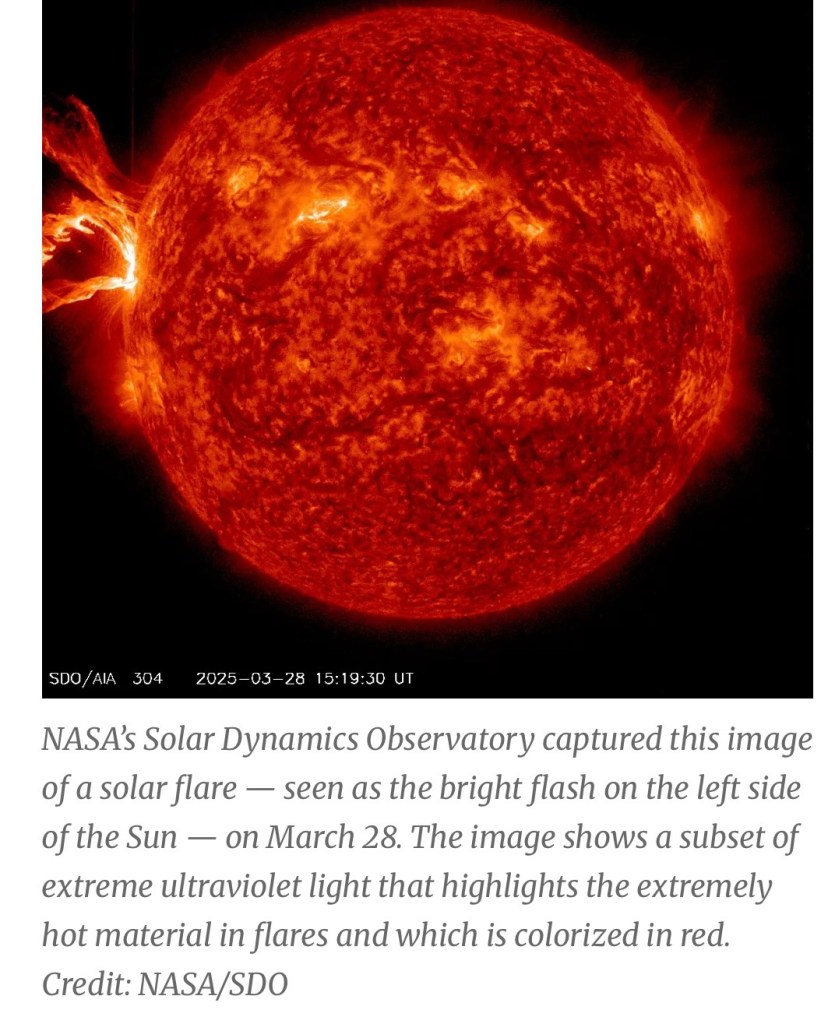
On Friday, the sun cast a solar flare and a CME, both of which cause geomagnetic disruptions.
Solar flares are bursts of electromagnetic radiation that travel at the speed of light, reaching Earth in just over 8 minutes.
Coronal mass ejections (CMEs) are large expulsions of plasma and magnetic field from the sun’s atmosphere — the corona.
CMEs highest speeds are almost 1,900 miles per second and can reach Earth in about 15 to 18 hours whilst slower CMEs traveling around 155 mi/s can take several days to arrive.
If a CME is large enough and travels faster than the solar wind it generates a shock wave whereby accelerated charged particles travel ahead of the CME further disturbing space weather conditions and intensifying geomagnetic storms.
Aurora displays are formed when disturbances in Earth’s magnetic field funnel ions down towards Earth’s poles where they collide with atoms of oxygen and nitrogen in the Earth’s atmosphere.
Auroras are usually confined to the polar regions but during large magnetic disturbances — triggered by a CME — auroras can be seen at much lower latitudes.
CME’s can cause damage and disruptions to:
- Electrical systems
- GPS
- Satellites
- Radios
An CME in 1859 caused worldwide telegraph system failures – operators reported receiving electric shocks and sparks showered from telegraph machines setting paper on fire. A 1989 CME caused an electrical blackout for the entire province of Quebec, Canada, that lasted 12-hours and caused at least $10 million in damages.
CMEs can cause surges in electrical currents which overload power grids causing widespread blackouts.
They can jostle the Earth’s magnetic field which can impair radio transmissions and increase radio static in Earth’s ionosphere.
GPS systems are particularly vulnerable to disturbances in the ionosphere and GPS coordinates have been known to stray by tens of feet during a CME event. The disruption occurs because GPS uses radio signals to relay information between a satellite and a ground receiver. The radio signal passes through the ionosphere layer containing charged plasma that bends the path of the GPS signal in a similar fashion to lens bending light. Normally, GPS systems can compensate for this bending of the radio signal, leaving the accuracy of GPS unaffected. However, during a CME event, the ionosphere can be so severely disturbed that the GPS models cannot keep track of such changes and receivers can no longer calculate an accurate position.
Affects on the Body
Our bodies are made of light & energy. It seems to me that if solar events can disrupt electrical systems, of course it can disrupt our human system. Moreso, I feel it.
Heliobiology is the study of the suns influence on life.
The Schumann Resonance (SR) is a set of spectrum peaks in the extremely low frequency portion of the Earth’s electromagnetic field spectrum.
Some of the studies mentioned in the article below note a correlation between variations in the SR and various human health issues, such as altered blood pressure and melatonin levels, which in turn have been associated with increased rates of cancer, reproductive, cardiac, and neurological diseases. These studies show:
- Humans may have a sensory system that responds to magnetic fields, which could potentially influence brain waves and behavior.
- Cryptochrome is a class of flavoproteins that are sensitive to blue light and are involved in the regulation of circadian rhythm. The pineal gland is influenced by light exposure and is responsible for the production of melatonin, a hormone that helps regulate sleep-wake cycles. Solar disturbances can affect these cycles.
- There is an increase in the rate of myocardial infarction and related deaths during geomagnetic storms.
- Solar storms may influence mood and cognitive function, potentially exacerbating conditions like depression and anxiety.
Key Sources:
https://www.space.com/coronal-mass-ejections-cme
Heliobiology: Unraveling the Sun’s Influence on Human Health
 PhilippiJoy